

Australia and Indonesia Strengthen Collaboration on Sustainable Materials Research Through the Collaboration of UniSQ, CFM, and Jiva Catalyst
Written by: Syifa Nasywa Nayla & Nouval Agung Bima
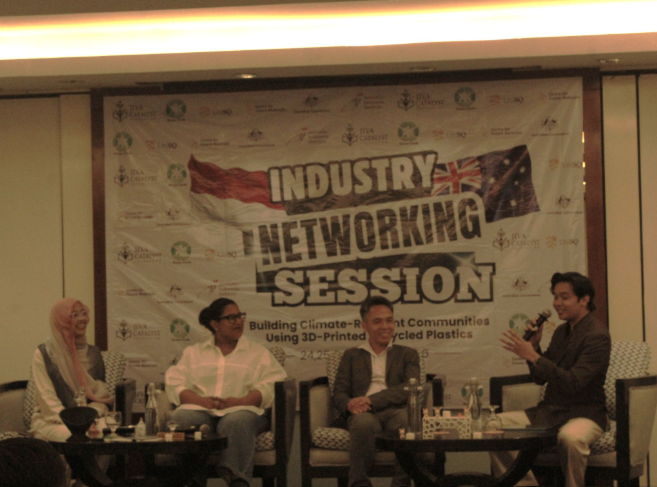
Jakarta, September 25, 2026 – Researchers, academics, and industry players from Australia and Indonesia met in Jakarta as part of the Australia-Indonesia Circular Materials & Advanced Manufacturing Engagement Program on September 24-25, 2026. This activity provided a space to exchange knowledge and discuss opportunities for collaboration in the development of sustainable materials, manufacturing technology, and the use of research results to meet industry needs.
This program is supported by the Australian Government’s Department of Foreign Affairs and Trade (DFAT), with the involvement of the University of Southern Queensland (UniSQ) through its Centre for Future Materials (CFM). The series of activities included a networking and research sharing session on September 24 at Le Méridien Jakarta, followed by an industry visit on September 25.
A total of 50 participants from 13 invited guests and the public attended this series of activities. Participants came from Universitas Pembangunan Jaya Bintaro, the Ministry of Forestry, and Fergi associates.co, with diverse backgrounds ranging from academics, researchers, consultants, and industry representatives.
In this activity, participants not only discussed research developments but also examined how materials research can be used to address emerging challenges in the field. One topic discussed was research on the use of recycled plastic to produce reusable materials in manufacturing processes.
“As a country with a large population, we produce a lot of single-use plastic that is only used for a few hours and then discarded. This is a problem that the government should address. Through this forum, we can assimilate research from Australia into Indonesia.” – Robiatul Adawiyah.
Robiatul Adawiyah, a PhD student in Materials Engineering at UniSQ, shared her research on the use of recycled thermoplastics combined with continuous glass fiber to produce a composite material that can be used as a filament in 3D printing. This research started from the issue of plastic waste and how this material can be repurposed through processing and material development. For Adawiyah, the development of sustainable materials does not stop at how waste can be recycled, but also how the recycled materials can be used to produce products with good performance. This approach is one example of how research on circular materials can be developed for industrial needs.
In addition to research sharing sessions, the event also brought researchers together with various parties from Indonesia to discuss industry needs and challenges. These discussions are expected to provide a foundation for identifying more concrete collaboration opportunities, both in research, technology development, and the utilization of research findings.
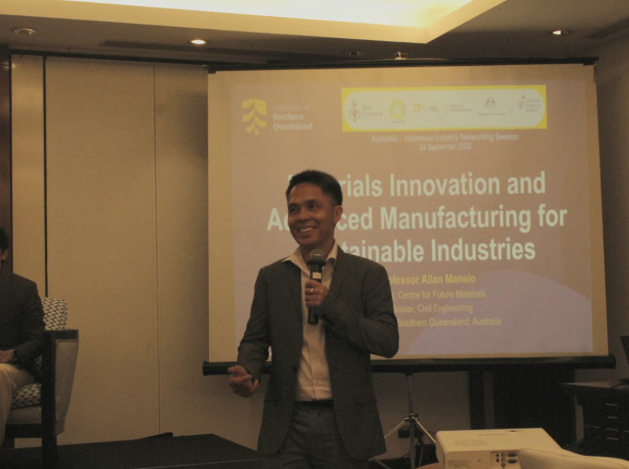
“Today, we’re talking about more than just CFM. We’re talking about global challenges and the collaborations we can build to address them. This networking event serves as a platform for us to connect, exchange ideas, and explore opportunities for collaboration” – Prof. Allan Manalo
Prof. Allan Manalo is a Professor in Civil Engineering at UniSQ and Director of the Centre for Future Materials. CFM is a research center focused on materials development and advanced manufacturing, including advanced composites, sustainable materials, digital manufacturing, materials testing and characterization, and energy and functional materials. CFM has also collaborated with more than 1,000 industrial clients on various materials development and testing projects.
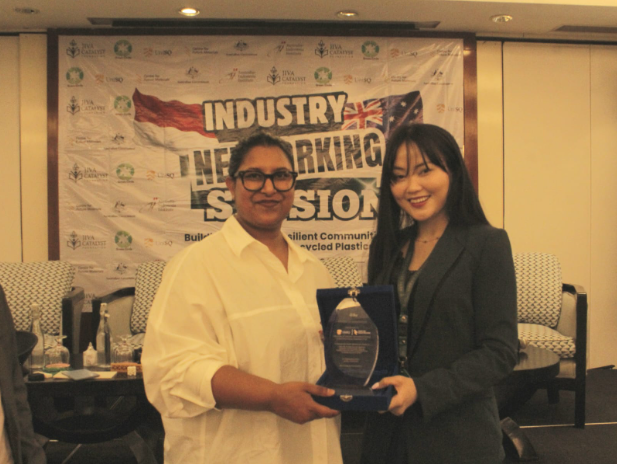
“My main focus is trying to use all these plastics and convert them into a composite, specifically fiber reinforced composite. Hopefully use that advanced material in our civil infrastructure. So we are not completely replace all the civil infrastructure, but at least try to repurpose plastic into some useful application” – Dr. Sachini Wickramasinghe
Dr. Sachini Wickramasinghe is Project Lead in the project Building Climate-Resilient Communities Using 3D-Printed Recycled Plastics developed by CFM, UniSQ. In this project, he played a role in leading the development of an initiative that integrates the utilization of recycled plastic through technology 3D printing as part of efforts to build communities that are more resilient to climate change.
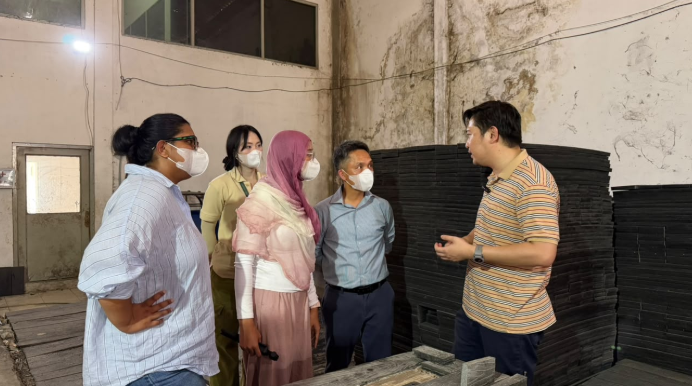
On the second day, the activities continued with an industrial site visit in Jakarta. This visit provided participants with an opportunity to directly observe the facilities and processes in operation in the industry, as well as discuss technical issues that could inform future research development and collaboration.
From this series of activities, one of the results that was noted for follow-up cooperation between Australia and Indonesia in the field of circular materials and advanced manufacturing is the opening of opportunities for future collaborative research. This activity provides an initial platform to introduce the potential, needs, and developments in the field, while also providing opportunities for parties to explore relevant research topics. Although it has not yet resulted in a concrete form of research collaboration, there is an openness to developing communication and exploring opportunities for future research which can support the development of innovation and the implementation of sustainable technology in both countries.
Industry site visit was held in PT Jangjo Technology Indonesia, Cengkareng, West Jakarta. Jangjo is a waste management company that prioritizes innovation and sustainability. The company strives to provide comprehensive waste management solutions while encouraging the adoption of more sustainable practices to support environmental sustainability and benefit the community.
Through this meeting, it is hoped that collaboration between researchers, academics, and industry can continue to develop, bringing research closer to real-world needs. Sustainable materials development should not only be discussed in the research room but can also be directed towards applications that benefit industry and the environment.
About Jiva Catalyst Foundation
Jiva Catalyst Foundation is a non-profit organization focused on education, green innovation, and community empowerment to support an inclusive and equitable energy transition. It operates through three main pillars 1) Education & Capacity Building; 2) Innovation & Green Solutions; and 3) Social Inclusions & Empowerment. Jiva develops various initiatives to promote sustainability education, green solutions, and community engagement. Jiva is also committed to expanding opportunities for youth, women, and underrepresented groups in the green economy.
About Centre for Future Materials
The Centre for Future Materials (CFM) is part of the University of Southern Queensland (UniSQ), Australia, conducting research in advanced materials and advanced manufacturing. CFM has over 30 years of experience in materials research and collaborates with over 1,000 industrial clients. Its research interests include advanced composites, sustainable materials, digital manufacturing, energy and functional materials, and materials testing and characterization.
For media inquiries, please contact:
Email: jiva.catalyst@gmail.com
Email: jivapartnership@gmail.com
Instagram: @jiva.catalyst
Address: Equity Tower, 26th Floor, Jl. Jenderal Sudirman, Senayan, South Jakarta 12190
Edited by: Anisa Khalilatuz Zahra