

Kalimantan and the Fires That Keep Returning
Written by: Syifa Nasywa Nayla
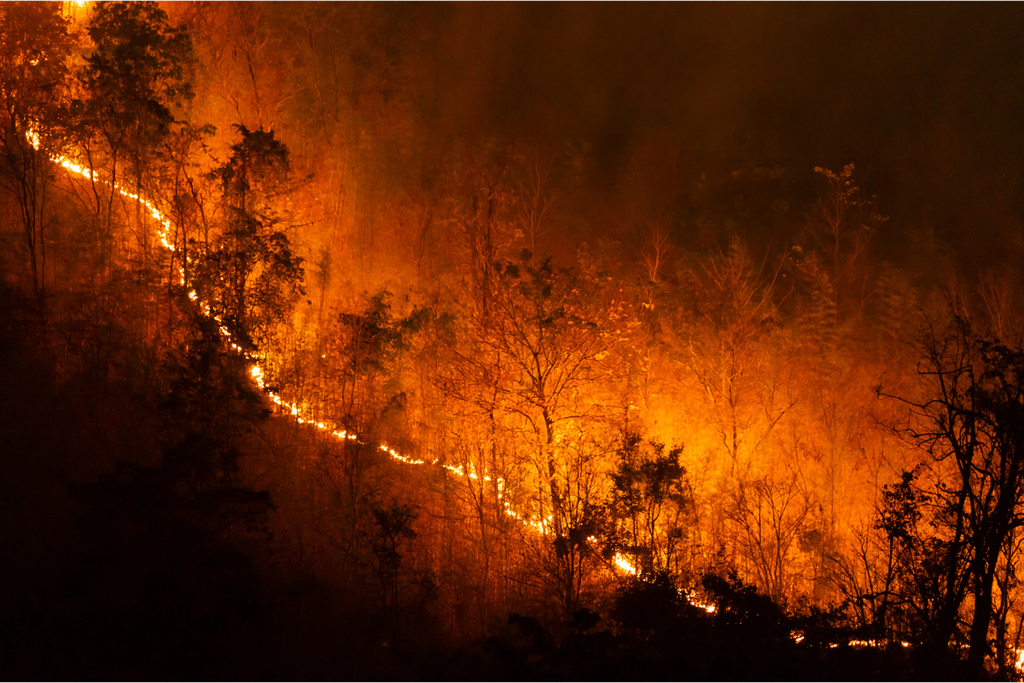
Source: Kompas.com
The haze has blanketed the island of Kalimantan. Forest and land fires (Kebakaran Hutan dan Lahan or Karhutla) are not only burning forests and land, but also worsening air quality and increasing the risk of acute respiratory infections (ISPA) among communities. In several areas, air quality has even reached alarming levels. This situation is becoming increasingly serious as the fires occur before the dry season has reached its peak.
Wahana Lingkungan Hidup Indonesia (Walhi) found that most hotspots in Kalimantan are located within corporate concession areas. Walhi recorded 34,262 hotspots and 33,837 hectares of burned area from January to July 2026. This is particularly concerning given that the dry season has not yet reached its peak. Nationwide, the accumulated number of hotspots reached 118,420, with an indicative burned area of 107,649 hectares.
These figures show that forest and land fires cannot simply be viewed as a matter of the dry season. When most hotspots are located within concession areas, issues concerning permits, land management, monitoring, and the responsibility of concession holders also need to be examined. The presence of hotspots within concession areas does not necessarily prove that the fires were caused by companies. However, this situation demonstrates the need for serious monitoring and investigation.
Badan Meteorologi, Klimatologi, dan Geofisika (BMKG) predicts that West Kalimantan will continue to receive rainfall, yet hotspots continue to emerge. BMKG considers poor forest and land governance that has persisted for years to be a fundamental underlying cause. The large number of business permits operating within peat hydrological units in West Kalimantan is also an issue that needs attention, considering that peatland areas are highly vulnerable to fires when they are drained and degraded.
The impacts of forest and land fires do not stop at the areas that are burned. Smoke haze disrupts visibility and people’s daily activities, while also increasing exposure to particulate matter from combustion that can enter the respiratory system. Vulnerable groups such as children, older people, and people with certain health conditions face greater risks when air quality deteriorates. When forests and land burn, the impacts are also directly connected to health, daily activities, education, and people’s livelihoods. Therefore, forest and land fires are ultimately not merely an environmental issue, but also concern the public’s right to a good and healthy environment.
Amid the worsening situation of forest and land fires, the government’s preparedness appears weak. The 2026 budget for Badan Nasional Penanggulangan Bencana (BNPB) is only around IDR 3 to 4 trillion. This is a very low figure compared to the allocations during the forest and land fire crises in 2015, 2019, and 2022–2024. Moreover, this budget is not allocated specifically for forest and land fires, but for all types of disasters.
This limitation becomes a problem when forest and land fires require a rapid and layered response, ranging from hotspot monitoring, patrols, and early firefighting to community support, health impact management, and ecosystem restoration. Communities that have long been on the front lines of firefighting are instead bearing a heavier burden due to limited facilities and funding. Yet this critical situation requires a rapid response, as well as preventive measures taken before fires spread further.
The government needs to improve natural resource governance. President Prabowo must evaluate all business permits, particularly those operating in peatland areas and natural forests. Companies with problematic permits must face appropriate measures, including permit revocation in accordance with applicable laws and regulations. At the same time, corporations must be held responsible for financing ecosystem restoration and addressing the impacts of forest and land fires if they are proven to be responsible for the damage that has occurred.
A review is also needed of regulations that conflict with the mandate of TAP MPR Nomor IX Tahun 2001 on Agrarian Reform and Natural Resource Management. This mandate is important as a basis for reconsidering how natural resources are managed, including how business permits are granted and how ecological interests and communities are protected.
These demands for evaluation and accountability are beginning to intersect with law enforcement efforts. Prasetyo Hadi, Indonesia’s Minister of State Secretary, stated that four companies are currently under investigation in connection with forest and land fires in West Kalimantan. The investigation is important to determine whether violations or negligence in land management contributed to the fires.
However, the investigation into these four companies should not end as a response to the fires currently taking place. If violations are found, legal proceedings must continue toward accountability and restoration. At the same time, the government needs to use these cases as an opportunity to conduct a broader evaluation of permits and land governance.
The issue of forest and land fires is not only about how to put out fires that have already started. The question is why fires continue to have room to emerge again. As long as forest and land governance, permit oversight, peatland protection, government preparedness, and corporate accountability are not seriously addressed, communities will continue to face the same impacts: forests burning, air quality deteriorating, health being threatened, and haze once again covering Kalimantan.
Source:
https://www.bbc.com/indonesia/articles/c36dgk5de85o