

From 1,000 Trees to a Community Carbon Asset: Building Decentralized Carbon Incentives in Parung Panjang
Written by: Nouval Agung Bima
Climate action doesn’t always have to start with large-scale projects. Within residential areas, previously underutilized public spaces can also be part of efforts to address climate change. Through “Rooting the Future”, The Jiva Catalyst Foundation initiated the planting of 1,000 trees in Somang Village, Parung Panjang, on April 25, 2026. This activity involved 100 volunteers coordinated by 20 internal Jiva Catalyst coordinators, with seed support from the Citarum Ciliwung Watershed Management Center (BPDAS). However, tree planting is not just about planting and leaving the trees to grow. The broader question is, “How can community-level reforestation actions provide long-term benefits for the environment and the people who care for it?”
This question underpins the development of the concept of decentralized carbon incentives in a study by the Jiva Catalyst Foundation. Through this approach, trees planted in communal public spaces are viewed not only as part of reforestation but also as ecological assets with the potential to provide economic benefits to communities if integrated into carbon market mechanisms.
When Public Space Becomes Part of Climate Action
In many peri-urban areas in Indonesia, public land, a shared community asset, remains underutilized as green space. Yet, the presence of trees in densely populated areas can provide both ecological and social benefits, from helping to lower temperatures to creating a more comfortable environment. Furthermore, green spaces also have economic potential that can be developed as attention grows on climate action and carbon markets.
In Indonesia, the development of carbon policy through the Indonesian agenda Forestry and Other Land Use Net Sink 2030 and Minister of Forestry Regulation No. 6 of 2026 further open up opportunities for community involvement in carbon mechanisms. These developments demonstrate that emission reduction and carbon sequestration actions need not be limited to large-scale projects but can also begin at the community level. When environmental benefits go hand in hand with economic benefits, communities have the opportunity to play an active role in maintaining environmental sustainability.
Turning Tree Planting into a Community Asset
Non-agrarian residential areas in peri-urban areas like Parung Panjang present unique challenges. Communal public land is often underutilized as green space, while surrounding communities demand shadier, healthier, and more sustainable spaces.
Through “Rooting the Future” 1,000 tree seedlings were planted on communal public land that previously lacked tree cover. The tree species planted included sengon, balsa, avocado, manglid, jackfruit, and jengkol. This composition combined relatively fast-growing trees with potential economic benefits for the community.
This approach demonstrates that greening can be designed not only to produce ecological benefits, but also to build long-term relationships between communities and the public spaces they manage.
From Trees to Carbon Incentives
One of the challenges in bringing community tree planting actions into the carbon mechanism is cost. Measurement, Reporting, and Verification (MRV) is relatively high. On the other hand, the program’s success also depends heavily on the community’s ability to maintain the trees’ survival and growth over the long term.
Source: Jiva Catalyst Foundation
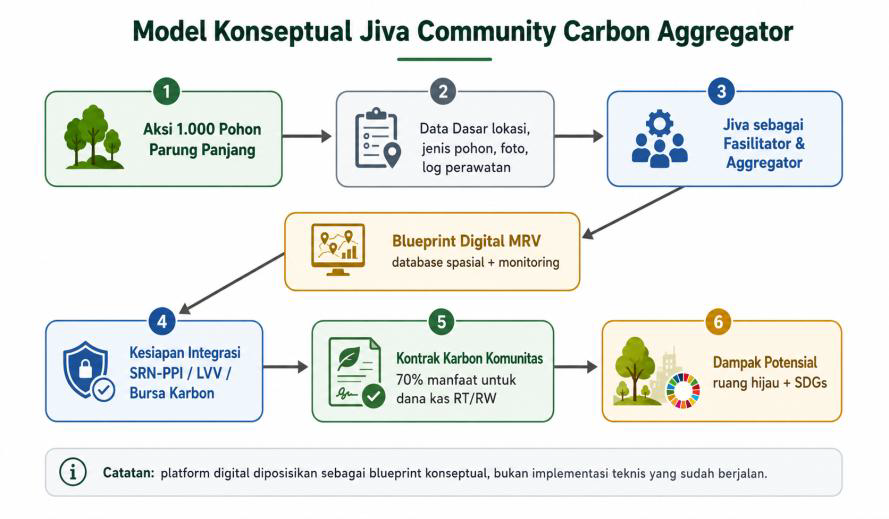
To address these challenges, the Jiva Catalyst Foundation study proposes a digital carbon aggregator with a three-tier system. At the first level, the community or neighborhood units (RT/RW) managers collect data such as GPS coordinates, periodic documentation, and the number of surviving trees. This data is then processed through the system digital monitoring, reporting, and verification (dMRV) to assist in mapping, biomass estimation, and vegetation cover validation. In the next stage, these results have the potential to be linked to the National Climate Change Management Registry System (SRN-PPI) and the SPE-GRK mechanism.
With this model, technology serves more than just a record-keeping tool. The digital system is expected to help reduce initial transaction costs in the MRV process while creating a more transparent system for monitoring tree sustainability.
When Carbon Benefits Return to Communities
An important consideration in this model is who benefits from the carbon value generated.
In the proposed Community Carbon Contract concept, 70% of carbon revenue is allocated to the neighborhood association (RT/RW) community fund. This mechanism is designed to create a direct link between successful tree preservation and the benefits received by the community. This way, the community is not only the implementer of tree planting activities but also part of the beneficiaries of environmental sustainability efforts.
This approach also opens up opportunities for community groups that may not have previously been widely involved in the green economy, including youth, female-headed households, people with disabilities, and vulnerable groups. This involvement is part of the concept. Nature-based Opportunities for Livelihoods and Business (NOLB), namely how environmental action can simultaneously open up livelihood opportunities and social benefits.
So, how big is the impact?
Based on the allometric simulations used in the study, 1,000 planted trees are projected to cumulatively sequester approximately 95.99 tons of CO₂e. After accounting for a 20% buffer to maintain permanence, the calculated potential is approximately 77 SPE-GRK units.
However, it is important to understand these figures as projections, not as verified carbon credits.
The calculations are still based on simulations of allometric coefficients and have not undergone third-party verification or long-term field validation. Therefore, the success of this model ultimately depends on tree survival rates, growth monitoring, and compliance with applicable regulations.
Linking Local Action to the Sustainable Development Goals/Sustainable Development Goals (SDGs)
More than just planting trees, this approach shows how community-level action can connect to a broader sustainable development agenda.
Planting 1,000 trees contributes to SDG 13 (Addressing Climate Change) through community-based mitigation efforts and SDG 15 (Ecosystems on Land) through the restoration of green spaces. Furthermore, greening public spaces supports SDG 11 (Sustainable Cities and Human Settlements), while engaging youth in vegetation monitoring can open up opportunities for SDG 8 (Decent Work and Economic Growth). Collaboration between communities, governments, and organizations also reflects the spirit of SDG 17 (Partnerships for the Goals).
Thus, the trees growing in Somang Village not only have ecological value but also have the potential to become part of a more inclusive social and economic ecosystem.
From Long Parung to a Replicable Model
Experience “Rooting the Future” demonstrates that community-based climate action has the potential to be further developed. Seed support from the BPDAS helped overcome initial capital barriers, while the involvement of volunteers and community groups demonstrated the importance of social capital in ensuring the program’s sustainability.
However, challenges remain, particularly regarding legal certainty regarding community carbon claims on non-forestry public lands. This study highlights the need for strengthened regulations, including those regarding community carbon rights or claims and community carbon contract mechanisms.
Going forward, this model can be developed through long-term monitoring, strengthening community capacity, developing a dMRV system, and collaborating with the government, universities, and various other stakeholders. One recommendation is to recognize the role of RT/RW as managers of carbon assets and integrate the resulting economic benefits into village development.
Ultimately, the 1,000 trees in Parung Panjang can be more than just a number. They can be the starting point for building a model where reforestation, technology, carbon policy, and community empowerment work together.
Through decentralized carbon incentives, climate action can move closer to communities, not just as programs implemented for communities, but as systems built on and providing shared benefits to communities.
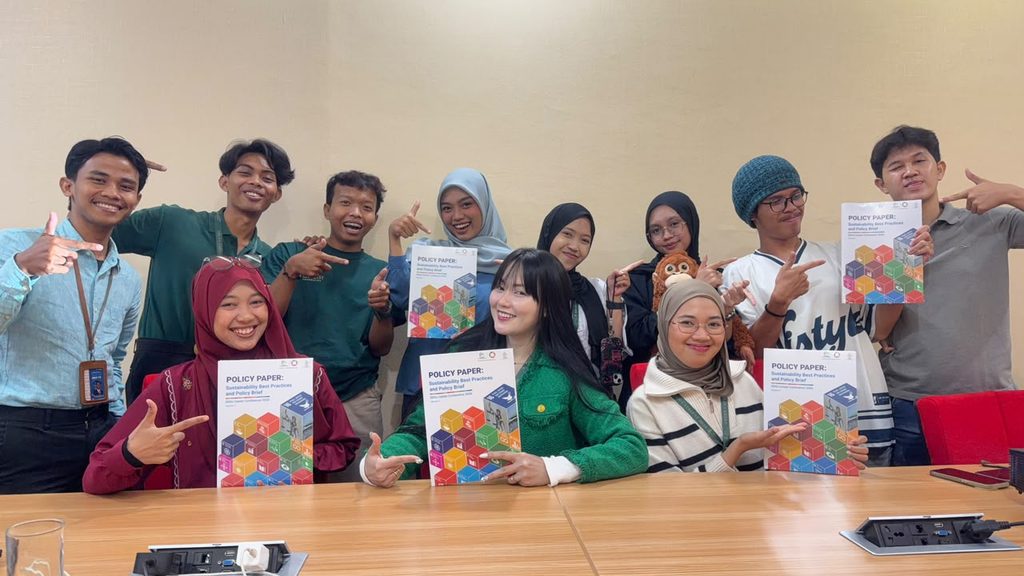
Let’s Read Policy Paper: Sustainability Best Practices and Policy Brief SDGs Center Conference 2026 Volume 4 for More Complete Information!

Source:
Lynn, M., Nurlaila, El Najma S., B., Nurrohmah, H., Ansyari, A. R., Farikha, M. S. N., Nayla, S. N., Damayanti, C. A., Wangi, K. P., & Hodijah. (2026). Decentralized carbon incentives for non-agrarian settlements: A case study of the Jiva Catalyst Foundation’s 1,000-tree action in Parung Panjang. InPolicy Paper: Sustainability Best Practices and Policy Brief SDGs Center Conference 2026 Volume 4 (pp. 118–128). Pertamina University. Pages 118-128.
Editor by: Anisa Khalilatuz Zahra